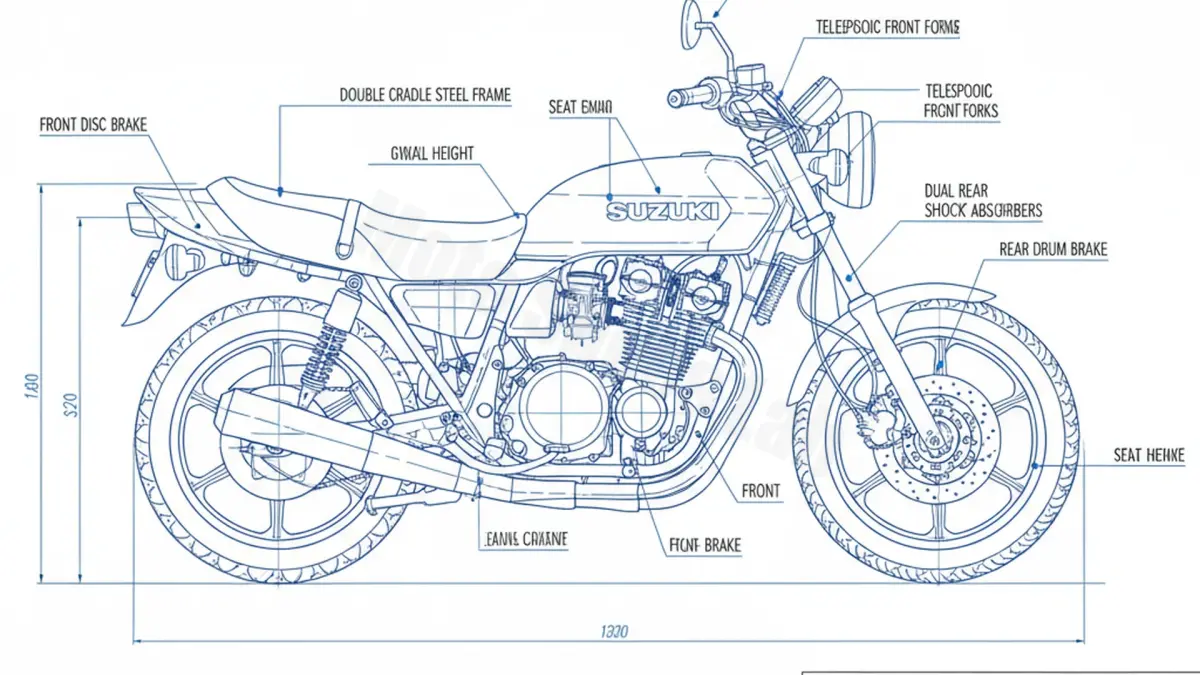
| Attribute | Specification |
|---|---|
| Production Years | 1980-1983 |
| Engine Type | 4-Stroke, Parallel Twin, TSCC |
| Oil Type | SAE 10W-40 API SE/SF (JASO-MA) |
| Oil Capacity | 2.4 Liters |
| Tires (Standard) | F: 3.00-18 / R: 3.50-18 |
| Tires (L-Model) | F: 3.25-19 / R: 130/90-16 |
| Tire Pressure | F: 2.0 bar / R: 2.25 bar |
| Spark Plug | NGK D8EA |
| Battery | YB12A-A |
Historical Engineering Highlight: The Suzuki GSX 400 (GS40X) marked a pivotal shift in mid-capacity motorcycle design as one of the first production machines to feature Suzuki’s proprietary Twin Swirl Combustion Chamber (TSCC). Unlike its predecessor, the GS series, the GSX 400 utilized a four-valve-per-cylinder head designed to induce a high-speed swirl of the air-fuel mixture, dramatically increasing combustion efficiency and power output without increasing displacement.
Technical Overview: The TSCC Revolution
At the heart of the GS40X is a 399cc DOHC parallel twin. The introduction of the GSX badge signified the move to four valves per cylinder. By positioning the valves in a cross-flow pattern, Suzuki engineers were able to create two distinct intake channels that forced the incoming charge into a double-vortex. This tech allowed the GSX 400 to achieve a level of throttle responsiveness and fuel economy that outclassed many of its contemporary rivals.
Maintenance Guide
Lubrication System
For optimal engine longevity, MotoSpecsLab recommends a high-quality SAE 10W-40 oil. Given the shared lubrication for the engine and gearbox, ensure the oil meets JASO-MA standards to prevent clutch slippage. The total capacity is 2.4 liters. We suggest oil changes every 3,000 miles (5,000 km) or annually.
Ignition and Electrical
The GS40X utilizes the NGK D8EA spark plug. Maintaining a precise gap is critical for the high-revving nature of the TSCC engine. The electrical system is supported by a YB12A-A lead-acid battery. Ensure terminals are clean and the charging system output is tested regularly, as these early 80s Suzuki units can be sensitive to regulator/rectifier age.
Chassis and Tires
The GSX 400 was offered in both the standard ‘Euro’ styling and the ‘L’ (Low-seat/Custom) variant. Note the distinct tire sizes: the standard model utilizes 18-inch wheels front and rear, while the L-model adopts a cruiser-style 19-inch front and a fat 16-inch rear. Regardless of the model, maintain pressures at 2.0 bar (28 psi) front and 2.25 bar (32 psi) rear for stable handling.
Expert Performance Review
From an editorial standpoint, the GSX 400/L remains a masterclass in the ‘Universal Japanese Motorcycle’ (UJM) evolution. The engine is remarkably smooth for a parallel twin, thanks to its counter-balancer. While the ‘L’ model offers a relaxed, feet-forward ergonomics profile, the standard GS40X provides a more neutral, sporty stance that highlights the frame’s surprisingly competent geometry. The braking system, typically a single disc up front, is adequate for its 27hp output but requires modern braided lines for improved feel.
Frequently Asked Questions (FAQ)
What is the oil capacity of the GSX 400?
The engine requires 2.4 liters of oil for a standard change.
Which spark plugs are best for the GS40X?
The factory-recommended plug is the NGK D8EA, which provides the correct heat range for the TSCC cylinder head.
Are the tires different between the GSX 400 and the GSX 400L?
Yes. The standard model uses 18-inch wheels (3.00-18/3.50-18), while the L-model features a 19-inch front (3.25-19) and a 16-inch rear (130/90-16).