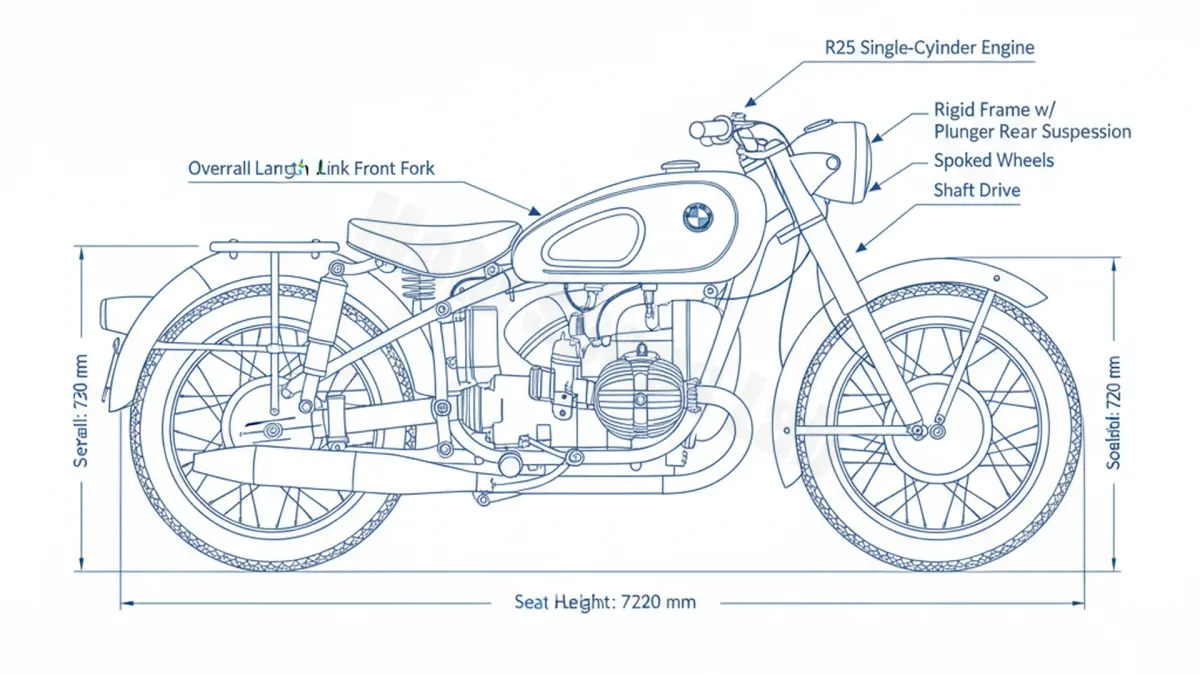
The BMW R 25 represents a pivotal moment in Bavarian motorcycling history. While its predecessor, the R 24, was a rigid-frame stopgap measure, the R 25 introduced plunger rear suspension to the 250cc single-cylinder class. This engineering leap not only improved rider comfort significantly but also signaled BMW’s return to premium manufacturing standards in the early 1950s, eventually leading to a production run of over 23,000 units within just two years.
| Component | Specification |
|---|---|
| Engine Type | 247cc Single-cylinder, 4-stroke |
| Engine Oil | SAE 30 Monograde (Mineral) (0.75 L) |
| Tires (F/R) | 3.25 x 19 / 3.25 x 19 |
| Tire Pressure (F/R) | 1.2 bar (17.4 psi) / 1.5 bar (21.7 psi) |
| Battery | DIN 00811 (6V 8Ah) |
| Spark Plug | Bosch W 240 T 1 (NGK B8HS) |
Technical Review: Plunger Suspension and Power Delivery
The R 25 utilized a welded tubular steel frame designed to withstand the rigors of sidecar attachment—a common requirement in post-war Europe. Its 247cc engine, producing approximately 12 hp, was paired with a four-speed gearbox operated via a foot-shift mechanism, which was still a relatively modern convenience at the time. The transition to the plunger frame allowed for better traction on the uneven surfaces of the era, making it a preferred choice for both commuters and touring enthusiasts.
Maintenance Guide & Preservation
Lubrication System
The R 25 uses a high-pressure lubrication system. For optimal engine longevity, MotoSpecsLab recommends SAE 30 Monograde Mineral oil. Modern multi-grade oils often contain detergents that can be too aggressive for the original seals and may keep debris in suspension that the centrifugal oil slinger cannot effectively manage. The capacity is a modest 0.75 liters, making frequent changes (every 1,500 – 2,000 km) essential.
Electrical & Ignition
Operating on a 6V DC system, the R 25 relies on the DIN 00811 (6V 8Ah) battery. Maintaining a clean ground connection is critical for the Noris generator’s efficiency. For the ignition system, the Bosch W 240 T 1 is the period-correct choice, though the NGK B8HS is the modern equivalent providing excellent heat dissipation and fouling resistance.
Chassis & Tires
Stability on the R 25 is highly dependent on tire pressure. Given the 3.25 x 19 dimensions on both wheels, the factory-specified 1.2 bar (Front) and 1.5 bar (Rear) should be adhered to strictly. Over-inflation can lead to a harsh ride due to the limited travel of the plunger suspension, while under-inflation will compromise the bike’s tracking in corners.
Frequently Asked Questions
Can I use synthetic oil in my BMW R 25?
No. Synthetic oils are generally not recommended for vintage engines of this era due to seal compatibility and the lack of a modern filtration system. Stick to high-quality SAE 30 mineral oils.
What is the benefit of the NGK B8HS over the original Bosch?
The NGK B8HS offers a more modern ceramic insulator and electrode design, which provides a more consistent spark and better resistance to carbon buildup under modern low-lead or unleaded fuels.