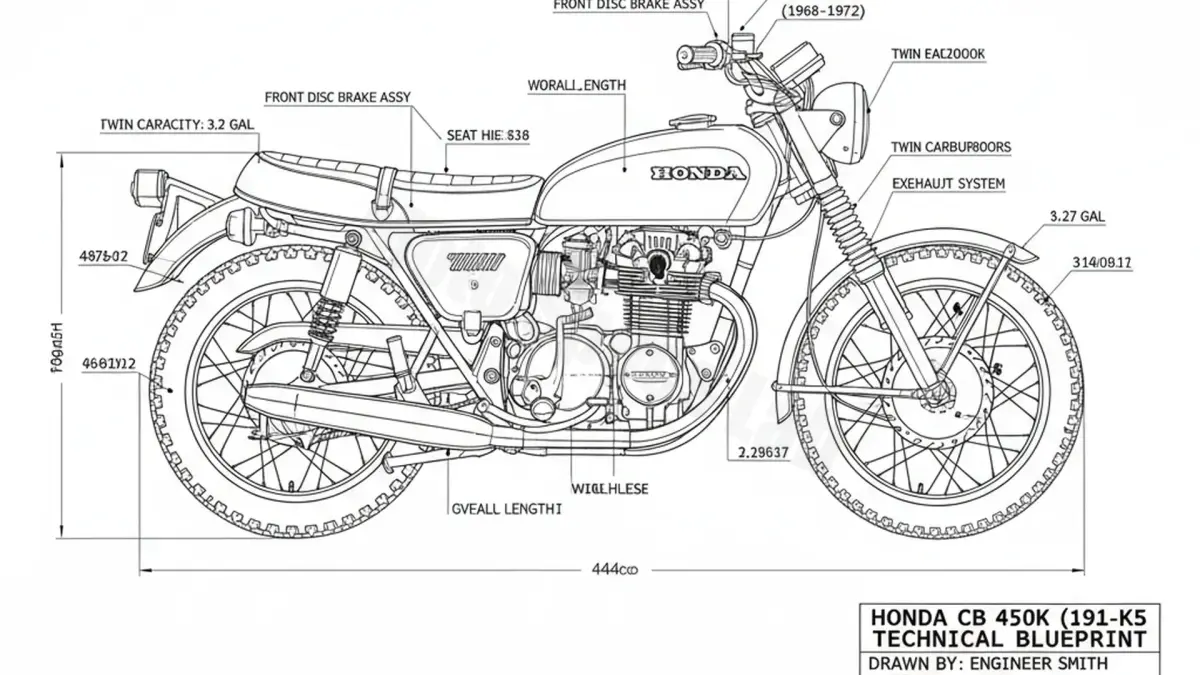
| Component | Specification |
|---|---|
| Production Years | 1968 – 1972 |
| Engine Oil | SAE 10W-40 JASO MA/MA2 (2.0 L) |
| Tires (Front/Rear) | 3.25 – 18 (4PR) / 3.50 – 18 (4PR) |
| Tire Pressure | F: 1.8 bar (26 psi) / R: 2.0 bar (28 psi) |
| Spark Plug | NGK B8ES |
| Battery | 12N12A-4A-1 |
At MotoSpecsLab, we recognize the Honda CB 450 K-series as a watershed moment in motorcycling history. While its predecessor, the ‘Black Bomber’, introduced the world to Honda’s ambitions, the K1 through K5 iterations refined a technology that was virtually unheard of in production motorcycles of the late 1960s: torsion-bar valve springs. Unlike traditional coil springs, these eccentric rods used twisting force to close the valves, allowing the CB 450 to rev safely to nearly 10,000 RPM—a feat that left contemporary 650cc British twins struggling to keep pace.
Engineering Deep-Dive: The DOHC Heart
The CB 450 K series featured a 444cc parallel-twin engine with Dual Overhead Camshafts (DOHC). This was a direct challenge to the industry standard of overhead valves (OHV) and pushrods. The torsion-bar system eliminated valve float at high frequencies, making the CB 450 one of the most reliable high-performance engines of its era. For the K1 through K5 models, Honda improved the five-speed transmission and updated the styling, moving away from the bulbous tank of the K0 toward a more streamlined, classic silhouette.
Maintenance Guide & Technical Essentials
1. Lubrication System
The CB 450 engine relies heavily on clean oil to protect its sophisticated valvetrain. We recommend using 2.0 Liters of SAE 10W-40. It is imperative to use a JASO MA or MA2 certified oil to prevent clutch slippage, as the engine and transmission share the same oil bath. Given the lack of a modern spin-on filter (using a centrifugal filter instead), oil changes should be frequent—every 1,500 to 2,000 miles.
2. Electrical and Ignition
The ignition system is a traditional points-and-condenser setup. To maintain peak combustion efficiency, use NGK B8ES spark plugs. The electrical system is powered by a 12V circuit, utilizing a 12N12A-4A-1 battery. Owners should regularly check the charging system, as the early permanent magnet alternators can be sensitive to age and heat.
3. Chassis and Handling
The handling of the CB450K is highly dependent on correct tire selection and pressure. The factory specifications call for a 3.25 – 18 front and a 3.50 – 18 rear tire. For optimal stability and cornering, maintain pressures at 1.8 bar (26 psi) front and 2.0 bar (28 psi) rear. Modern rubber compounds in these vintage sizes can significantly improve the ‘planted’ feel of the bike.
MotoSpecsLab Verdict
The Honda CB 450 K1-K5 remains a masterclass in over-engineering. It proved that a smaller, high-tech engine could outperform larger displacement rivals through sheer efficiency and mechanical sophistication. For the collector or vintage rider, it offers a unique mechanical character that modern motorcycles simply cannot replicate.
Frequently Asked Questions (FAQ)
Q: Why does the CB 450 use torsion bars instead of coil springs?
A: Torsion bars were used to prevent valve float at high RPMs, which was a common limitation of the metallurgy used in coil springs during the 1960s.
Q: Can I use synthetic oil in my CB450K?
A: Yes, provided it is JASO MA rated. However, many owners prefer high-quality mineral oils to ensure compatibility with older seal materials.
Q: What is the most common mechanical issue?
A: Cam chain tensioner wear and oil pump priming are the most critical areas to monitor during long-term ownership.