| Component | Specification |
|---|---|
| Production Years | 2006 – 2012 |
| Engine Oil | SAE 10W-30 JASO MB (0.9 L) |
| Spark Plug | NGK CR8EH-9 |
| Front Tire | 110/90-13 M/C (56L) |
| Rear Tire | 130/70-13 M/C (63P) |
| Battery | YTZ7S |
| Front Pressure | 2.00 bar (29 psi) |
| Rear Pressure | 2.25 – 2.50 bar (33 – 36 psi) |
The Engineering Middle Ground: The 13-Inch Revolution
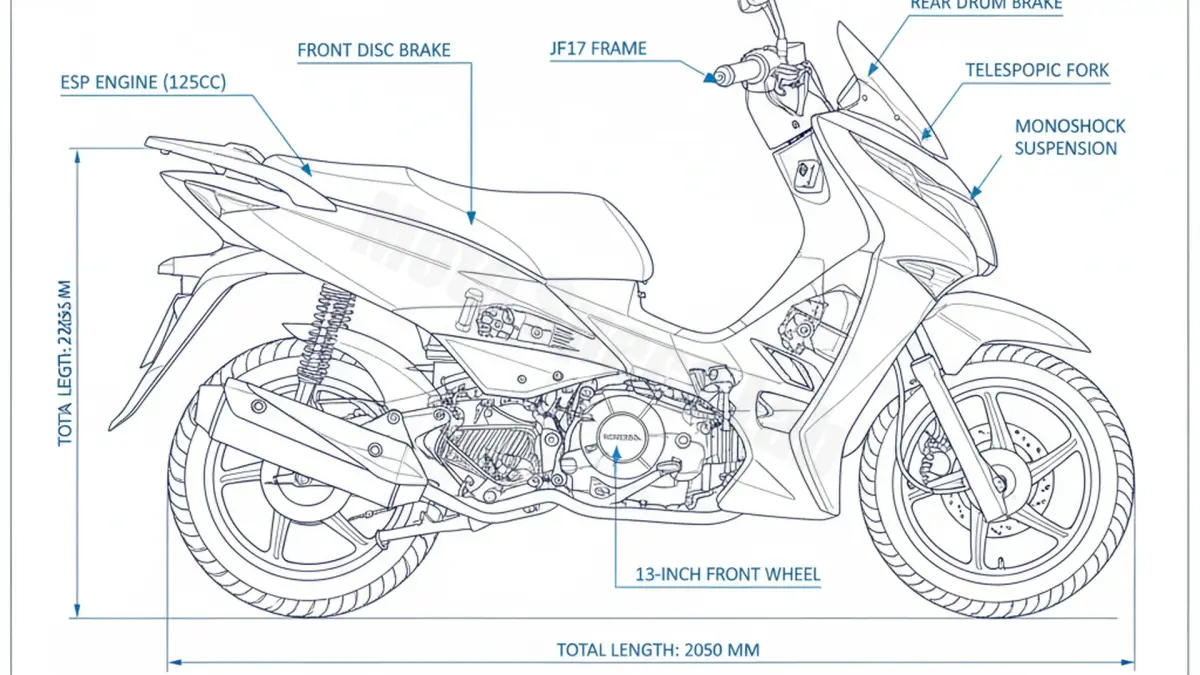
The Honda PS 125I, internal code JF17, occupies a unique historical position in Honda’s European lineup. While the SH series dominated with 16-inch wheels and the S-Wing catered to the maxi-scooter crowd, the PS 125I (Passion) was engineered specifically to utilize 13-inch wheels. This was a strategic engineering choice to offer a lower center of gravity and increased under-seat storage compared to the SH, without sacrificing the high-speed stability that 10 or 12-inch wheels often lack. This “mid-wheel” approach made the JF17 one of the most balanced urban commuters of its era.
Technical Maintenance Breakdown
Lubrication System
The JF17 engine is a precision-engineered liquid-cooled 4-stroke unit. It is critical to use JASO MB rated oil. Unlike most motorcycles that require JASO MA (for wet clutches), the PS 125I utilizes a dry centrifugal clutch and a CVT transmission. Using JASO MA oil can lead to unnecessary internal friction and reduced fuel economy. The capacity is a modest 0.9 liters, making frequent changes (every 4,000 km) both inexpensive and vital for longevity.
Ignition and Electrical
For optimal combustion efficiency and to maintain the PGM-FI (Programmed Fuel Injection) parameters, the NGK CR8EH-9 spark plug is the factory-mandated standard. Electrical stability is managed by the YTZ7S battery, a compact high-output unit designed to handle the frequent stop-start cycles typical of city commuting.
Chassis and Contact Patch
The handling characteristics of the PS 125I are heavily dependent on maintaining precise tire pressures. The 13-inch chassis is sensitive to under-inflation, which can lead to “heavy” steering. Always adhere to the 2.00 bar front and 2.25 bar rear (solo) specifications. If carrying a pillion, increasing the rear pressure to 2.50 bar is essential to prevent sidewall deformation in the 130/70-13 rear tire.
MotoSpecsLab Editorial Verdict
The Honda JF17 remains a masterclass in ergonomic packaging. By moving away from the large-wheel format of the SH, Honda created a machine that felt more planted in tight urban maneuvers while offering a more accessible seat height. Its fuel-injected engine is remarkably robust, provided the cooling system is maintained and the specific JASO MB oil requirement is respected. It is a testament to Honda’s build quality that many of these units remain in active service over a decade after production ceased.
Frequently Asked Questions
Q: Can I use 10W-40 oil instead of 10W-30?
A: While 10W-40 will not cause immediate damage, 10W-30 is recommended for optimal flow at startup and better fuel efficiency in the JF17 engine.
Q: How often should I check the coolant?
A: The liquid-cooled JF17 should have its coolant levels checked every 1,000 km, as the compact radiator is highly efficient but has a low total volume.