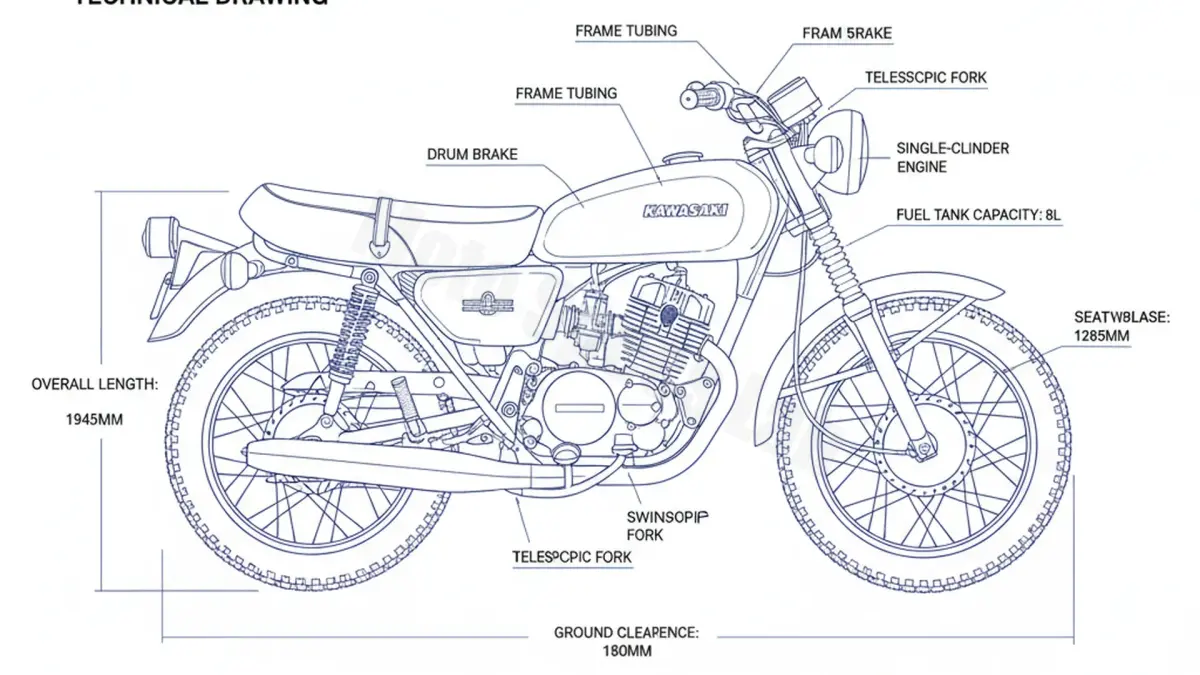
| Quick Specs: Kawasaki KM 100 (1976–1981) | |
|---|---|
| Engine Type | 99cc 2-Stroke, Rotary Valve Single |
| Engine Oil | SAE 10W-40 (0.7 L) |
| Spark Plug | NGK B7HS (Gap: 0.6–0.7mm) |
| Tires (F/R) | F: 2.75-14 4PR / R: 3.00-14 4PR |
| Tire Pressure | F: 18 psi (1.25 bar) / R: 21 psi (1.50 bar) |
| Battery | 6N6-3B (6 Volt) |
At MotoSpecsLab, we evaluate vintage machinery through the lens of engineering efficiency. A unique highlight of the Kawasaki KM 100 is its sophisticated Rotary Valve induction system. Unlike contemporary piston-port two-strokes of the late 70s, the KM 100 utilized a side-mounted disc valve to control intake timing. This allowed Kawasaki engineers to achieve a more precise fuel-air mixture across the powerband, resulting in a surprisingly linear torque curve for a 100cc machine.
Technical Engineering & Performance
Produced between 1976 and 1981, the KM 100 (KM100-A series) served as the quintessential entry-level dual-sport. Its 99cc engine was designed for durability rather than outright speed, though its lightweight chassis made it an exceptionally nimble trail bike. The inclusion of the 5-speed transmission allowed riders to maximize the small-displacement engine’s output, making it capable of light street commuting and moderate off-road excursions.
Maintenance Essentials
Maintaining a KM 100 requires attention to its specific two-stroke requirements and aging electrical system. Below are the critical service parameters for the KM100 series:
- Lubrication: The gearbox requires 0.7 liters of SAE 10W-40. We recommend a JASO MA or MA2 rated oil to ensure the wet clutch operates without slipping.
- Ignition: The NGK B7HS is the standard heat range plug. Ensure the gap is set strictly between 0.6mm and 0.7mm to maintain consistent spark under load.
- Electrical: The 6N6-3B battery is a 6-volt unit. Modern owners should check the electrolyte levels frequently, as these systems are prone to evaporation in warmer climates.
- Chassis & Tires: The 14-inch wheels require specific pressures for optimal contact patches. Maintain 18 psi in the front (2.75-14) and 21 psi in the rear (3.00-14).
MotoSpecsLab Editorial Verdict
The Kawasaki KM 100 remains a testament to Kawasaki’s commitment to small-bore engineering. While it lacks the raw power of the larger KD or KX series, its mechanical simplicity and the unique rotary valve design make it a prized possession for vintage collectors and beginner restorers alike. Its reliability is high, provided the 6V electrical system and rotary valve seals are maintained.
Frequently Asked Questions
A: Yes, provided it is a motorcycle-specific synthetic (JASO MA) that does not contain friction modifiers which could cause the clutch to slip.
A: The rotary valve allows for asymmetrical intake timing, which generally provides better low-end throttle response compared to traditional piston-port engines of that era.