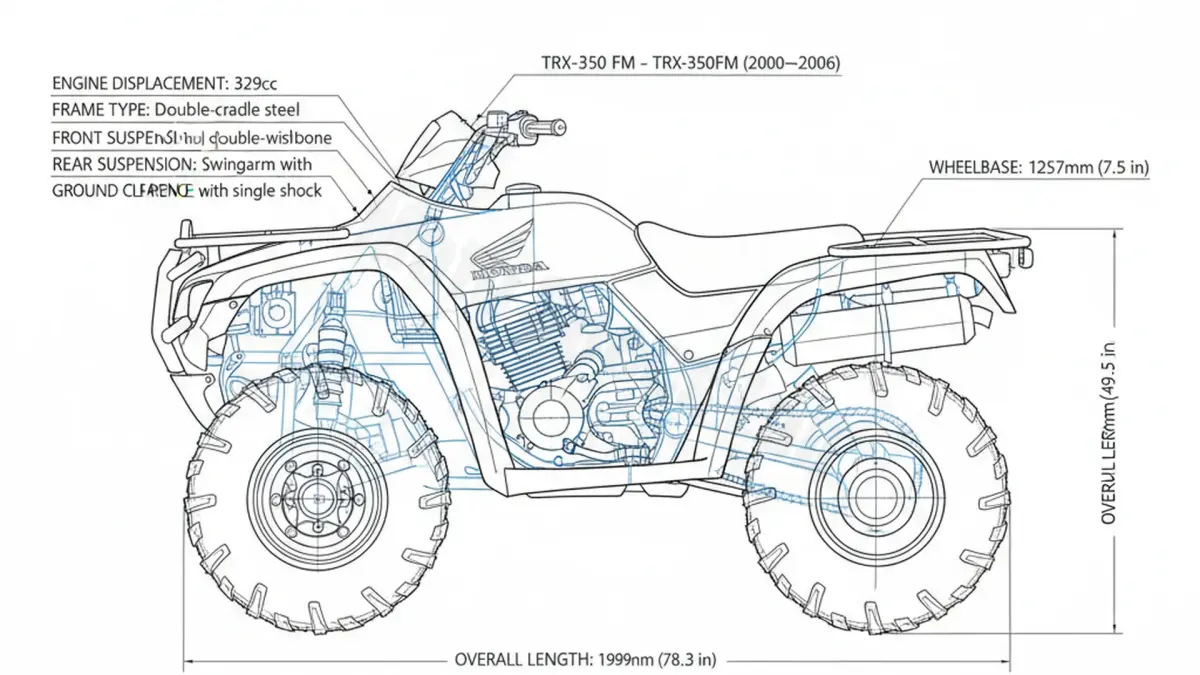
| Quick Specs: Honda TRX 350 FM | |
|---|---|
| Production Years | 2000–2006 |
| Engine Type | 329cc Air-cooled OHV Longitudinal |
| Oil Capacity | 1.9 L (SAE 10W-40 JASO MA) |
| Front Tires | 24 x 8-12 (3.6 psi) |
| Rear Tires | 24 x 9-11 (3.6 psi) |
| Battery | YTX14-BS |
| Spark Plug | NGK DPR7EA-9 / DENSO X22EPR-U9 |
The Honda TRX 350 FM (FourTrax Rancher 4×4) stands as a pivotal moment in utility ATV history. While competitors were focused on increasing displacement, Honda engineers focused on Mechanical Efficiency. The TRX 350 FM was the first in the Rancher line to utilize a longitudinal engine layout. By aligning the crankshaft with the driveshafts, Honda eliminated the need for power-robbing 90-degree gear turns in the primary drive, allowing more of the 329cc engine’s torque to reach the ground than many larger competitors of its era.
Technical Powertrain Analysis
At the heart of the TRX-350FM is a 329cc, air-cooled, overhead-valve (OHV) engine. This design prioritizes low-end grunt and thermal stability over high-RPM horsepower. The longitudinal orientation not only improves power transfer but also lowers the center of gravity, significantly enhancing off-camber stability—a critical factor for utility work in rugged terrain.
Maintenance Guide & Fluid Specifications
To maintain the legendary longevity of the TRX 350 FM, strict adherence to fluid specifications is mandatory. The engine utilizes a wet clutch system integrated with the transmission, necessitating the use of JASO MA rated oils. Using standard automotive oils with friction modifiers will cause premature clutch slippage.
- Oil Service: 1.9 Liters of SAE 10W-40. Check levels with the dipstick unscrewed (resting on the threads).
- Ignition: The NGK DPR7EA-9 is the standard heat range. Ensure a gap of 0.8–0.9mm to prevent carbon fouling or misfire under load.
- Chassis: The 4WD system is full-time, requiring periodic inspection of the CV boots and differential fluid levels to prevent moisture ingress.
Tire and Handling Dynamics
The TRX 350 FM utilizes a staggered tire setup (12-inch front rims and 11-inch rear rims). This specific configuration provides the optimal balance between steering precision and rear-end traction. Operating at the factory-specified 3.6 psi (0.25 bar) is vital; over-inflation leads to a harsh ride and reduced footprint, while under-inflation risks bead unseating during high-torque climbs.
Expert Verdict
The Honda TRX 350 FM remains a gold standard for reliability in the secondary market. Its lack of complex electronics and the presence of a manual foot-shift (FM designation) make it nearly indestructible. For owners, the key to its 20+ year lifespan is simple: clean air filters, JASO MA oil, and keeping the YTX14-BS battery on a tender during the off-season.
Frequently Asked Questions
Q: Can I use synthetic oil in my TRX 350 FM?
A: Yes, provided it is JASO MA certified. Synthetic 10W-40 can improve cold-start lubrication and high-heat stability.
Q: Why does the Rancher 350 use an 11-inch rear wheel?
A: The 11-inch wheel allows for a taller tire sidewall, which acts as a secondary suspension component, compensating for the solid rear axle’s limited travel.