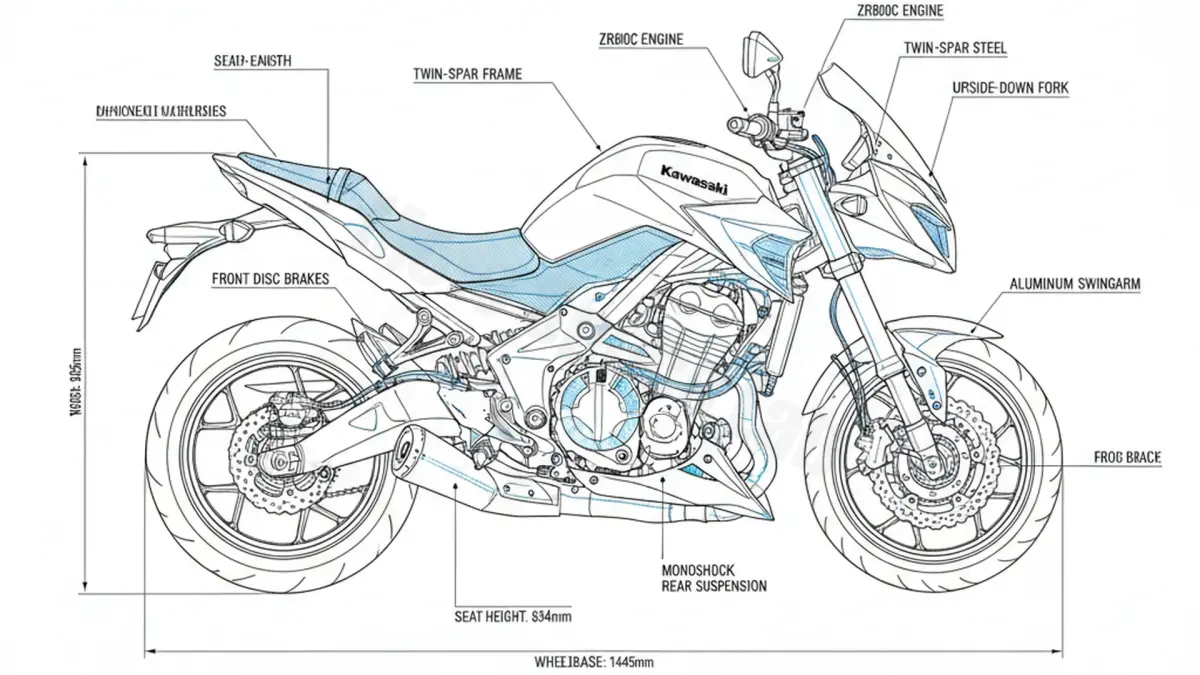
| Component | Specification |
|---|---|
| Engine Type | 806cc Liquid-cooled, 4-stroke Inline Four |
| Model Code | ZR800C (E Version) |
| Engine Oil | SAE 10W-40 JASO MA2 |
| Oil Capacity | 3.2 L (dry) / 3.4 L (with filter) |
| Spark Plug | NGK CR9EK |
| Battery | YT12A-BS |
| Tire Size | F: 120/70 ZR 17 / R: 180/55 ZR 17 |
A unique engineering highlight of the Kawasaki Z 800 E Version (ZR800C) is its specific design for the European A2 license category. Unlike the standard Z800, which produced 83 kW (113 hp), the ‘E Version’ was factory-detuned to exactly 70 kW (95 hp). This allowed it to meet the legal requirement that a restricted A2 motorcycle (35 kW) cannot be derived from a vehicle with more than double its power output. This strategic engineering choice made the Z800’s aggressive Sugomi styling accessible to a much broader demographic of riders.
Technical Maintenance & Lubrication
At MotoSpecsLab, we emphasize the importance of high-shear stability in inline-four engines. The ZR800C requires SAE 10W-40 JASO MA2 lubricant. When performing a standard service, ensure you have 3.4 liters available if you are replacing the oil filter. The use of JASO MA2 specification is critical to prevent clutch slippage in the wet-multiplate system.
Ignition and Electrical Systems
The ZR800C utilizes NGK CR9EK spark plugs, which are dual-ground electrode plugs designed to provide consistent ignition under high-load scenarios. For electrical reliability, the system relies on the YT12A-BS battery. Given the Z800’s high compression ratio, maintaining a healthy battery is essential for the starter motor to overcome initial resistance.
Chassis, Tires, and Safety
Handling precision on the Z 800 E Version is highly dependent on tire condition and inflation. The factory recommends a front pressure of 2.5 bar (36 psi) and a rear pressure of 2.9 bar (42 psi). The 180/55 ZR 17 rear tire provides a substantial contact patch, but running lower than recommended pressures can lead to sluggish turn-in and increased carcass heat.
FAQ
How often should I change the spark plugs?
Standard service intervals for the NGK CR9EK plugs are typically every 12,000 km (7,500 miles), though inspection every 6,000 km is recommended for optimal combustion efficiency.
Can I use a different oil viscosity?
While 10W-40 is the standard, 10W-50 may be used in extremely hot climates, provided it meets the JASO MA2 certification to protect the integrated gearbox.