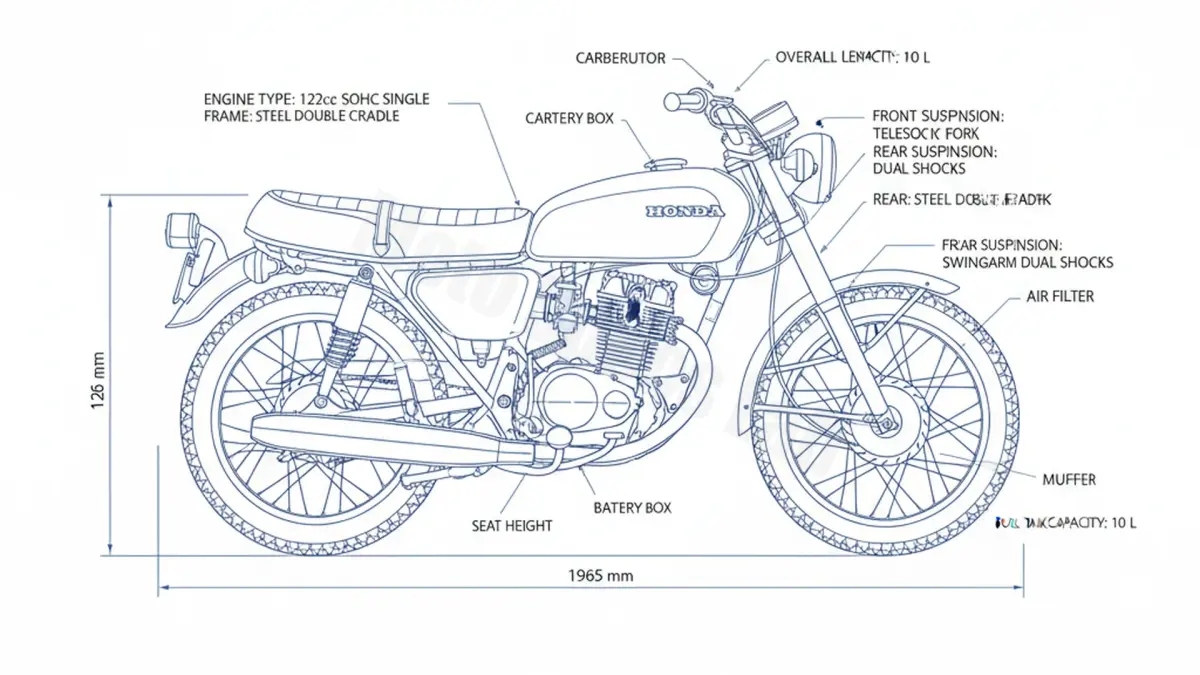
| Specification | Data / Value |
|---|---|
| Model Code | CB125J |
| Production Years | 1975 – 1979 |
| Engine Oil Type | SAE 10W-30 (API SE) |
| Oil Capacity | 0.9 Liters |
| Tire Size (Front/Rear) | F: 2.75-18 / R: 3.00-18 |
| Tire Pressure (Cold) | F: 1.75 bar (25 psi) / R: 2.0 bar (28 psi) |
| Battery Type | 6N6-3B (6-Volt) |
| Spark Plug | NGK D8EA |
Engineering Highlight: Unlike its twin-cylinder predecessors, the CB125J (CB 125 S) utilized a sophisticated overhead cam (OHC) single-cylinder engine that was specifically engineered to maximize volumetric efficiency while reducing mechanical complexity. This pivot allowed Honda to produce a lightweight commuter that could reliably sustain high RPMs, a feat that cemented the CB125’s reputation in both urban and developing markets.
Technical Review: The OHC Single Revolution
The Honda CB 125 S, specifically the CB125J variant produced between 1975 and 1979, represents the pinnacle of Honda’s small-displacement engineering during the 1970s. The transition from the CB125 twin to the single-cylinder OHC design was a strategic move to optimize fuel economy and ease of maintenance without sacrificing the “sporty” feel the CB line was known for.
The 124cc powerplant is a masterpiece of simplicity. It features a 5-speed constant-mesh transmission and a mechanical cable-operated front disc brake (on many J-models), which was a significant upgrade over the drum brakes of the era. The 6-volt electrical system, powered by the 6N6-3B battery, remains a quirk of the era that requires diligent maintenance of the contact breaker points and condenser to ensure consistent ignition timing.
Maintenance Protocol: Keeping the Legend Alive
1. Lubrication System
The CB125J relies on a wet-sump lubrication system. Given the lack of a modern spin-on oil filter, regular oil changes are critical. We recommend changing the 0.9 liters of SAE 10W-30 every 1,500 to 2,000 miles. Ensure the centrifugal oil cleaner is cleaned periodically to remove metallic particulates.
2. Ignition & Electrical
The NGK D8EA spark plug should be inspected for carbon fouling. The 6V system is sensitive to voltage drops; ensure the 6N6-3B battery terminals are free of corrosion and the electrolyte levels are maintained. If the bike struggles to idle, the contact breaker points gap (typically 0.3mm to 0.4mm) should be the first point of inspection.
3. Chassis & Tires
Handling on the CB 125 S is highly dependent on correct tire pressures. For the 2.75-18 front and 3.00-18 rear tires, maintain 25 psi and 28 psi respectively. Over-inflation leads to a harsh ride on the telescopic front forks, while under-inflation significantly compromises the stability of the lightweight frame in corners.
Editor’s Verdict
The Honda CB 125 S (CB125J) is more than a vintage commuter; it is a case study in efficient mechanical design. For the modern collector or enthusiast, it offers an accessible entry into vintage motorcycling with a parts availability that remains surprisingly robust. As long as the oil is fresh and the 6V system is healthy, this OHC single will continue to provide the reliable, high-revving performance Honda intended decades ago.