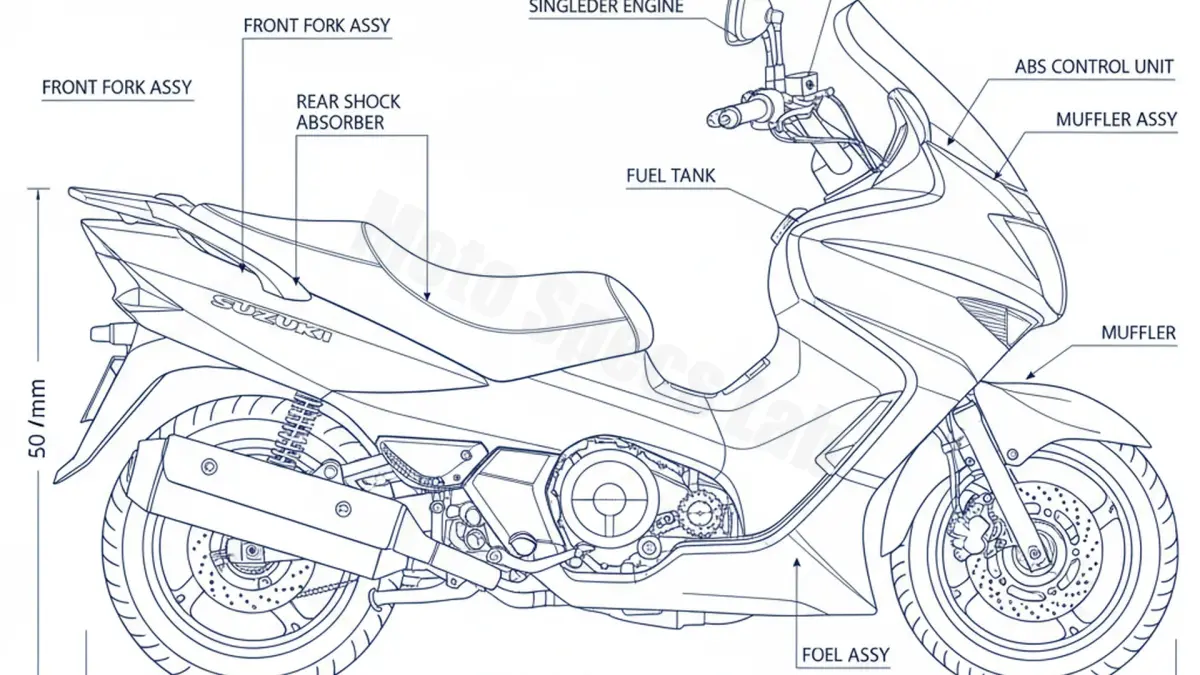
| Specification | Value |
|---|---|
| Production Years | 2007 – 2017 |
| Engine Oil | SAE 10W-40 JASO MA/MA2 (1.3 L) |
| Tires (F/R) | 120/80-14 M/C 58S / 150/70-13 M/C 64S |
| Tire Pressure (F/R) | 2.0 bar / 2.25-2.5 bar |
| Battery Type | YT12A-BS |
| Spark Plug | NGK CR7E |
Engineering Highlight: The 2007-2017 Suzuki Burgman 400 (WVCG) marked a pivotal shift in maxi-scooter engineering by introducing a liquid-cooled DOHC (Double Overhead Cam) engine, a rarity in its class at the time. This move significantly improved high-RPM efficiency and heat management compared to the previous SOHC designs, solidifying the Burgman’s reputation as a legitimate long-distance touring machine rather than just an urban commuter.
Technical Review: The Maxi-Scooter Standard
The WVCG generation of the AN 400 is widely regarded by technicians at MotoSpecsLab as the ‘sweet spot’ of the Burgman lineage. By increasing the front wheel size to 14 inches (from the previous 13), Suzuki addressed high-speed stability issues, providing a more motorcycle-like handling characteristic while maintaining the low center of gravity inherent to the step-through design.
The inclusion of the ABS system (Burgman Z models) utilized a sophisticated hydraulic control unit that integrated seamlessly with the dual front disc brakes. For the 2007-2017 era, this provided class-leading stopping power, essential for a machine with a curb weight approaching 220kg when fully fueled.
Maintenance Guide & Service Intervals
Lubrication System
The AN 400 requires 1.3 liters of SAE 10W-40 meeting JASO MA/MA2 standards. Despite being a scooter, the Burgman uses a wet-sump system that benefits from high-quality synthetic oils to protect the DOHC valvetrain. We recommend oil changes every 6,000 km (3,700 miles) or annually.
Chassis and Tires
Tire pressure is critical for the WVCG’s handling. The front 120/80-14 should be maintained at 2.0 bar (29 psi). The rear 150/70-13 requires 2.25 bar (33 psi) for solo use, but must be increased to 2.5 bar (36 psi) when carrying a passenger to prevent sidewall deformation and overheating.
Electrical & Ignition
The YT12A-BS battery is the heart of the Burgman’s complex electronics, including the immobilizer and ABS module. If the engine experiences hesitation, the first point of inspection should be the NGK CR7E spark plug, which is accessible via the maintenance hatch under the floor mat.
Frequently Asked Questions
Q: Why does the Burgman 400 require JASO MA oil if it has a CVT?
A: While the CVT itself is dry, the engine internal components and the starter clutch mechanism benefit from the specific friction modifiers found in JASO MA/MA2 rated oils.
Q: How often should the drive belt be inspected?
A: We recommend a visual inspection every 12,000 km. Look for cracks or glazing, as the WVCG’s high torque can accelerate wear on the V-belt.