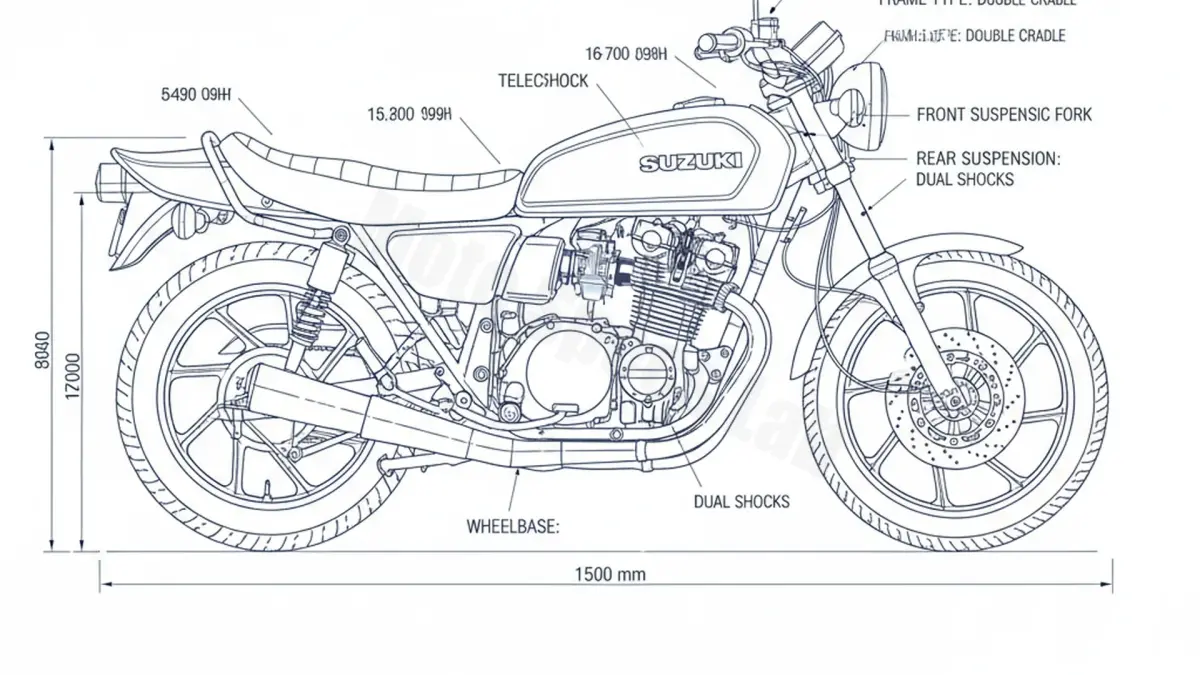
| Component | Specification |
|---|---|
| Production Years | 1979-1980 |
| Engine Oil | SAE 10W-40 (API SE/SF) – 3.2 Liters |
| Tire Size (Front/Rear) | 100/90-19 / 120/90-18 |
| Tire Pressure (F/R Solo) | 1.7 bar (25 psi) / 2.0 bar (28 psi) |
| Battery Type | YB14L-A2 |
| Spark Plug | NGK B8ES |
While most superbikes of the late 1970s relied on brute force, the Suzuki GS 1000 S achieved legendary status through a unique engineering focus on chassis rigidity and mass centralization. Often referred to as the “Wes Cooley Replica” due to its dominance in AMA Superbike racing, the GS1000S was the first Japanese production motorcycle to successfully prove that a liter-class machine could handle with the precision of a middleweight, thanks to its innovative air-assisted front forks and a frame that weighed significantly less than its competitors.
Engineering Analysis: The Gold Standard of the 70s
The heart of the GS1000S is its 997cc, DOHC, eight-valve four-cylinder engine. Unlike the heavy-set designs of its contemporaries, Suzuki engineers utilized a roller-bearing crankshaft and a slim engine profile that allowed for greater lean angles. The addition of the iconic bikini fairing on the “S” model was not merely aesthetic; it provided functional high-speed stability that was essential for long-distance endurance racing and high-speed touring.
Maintenance Guide & Lubrication
To maintain the mechanical integrity of this vintage powerhouse, precise lubrication is critical. The GS1000S utilizes a wet sump system requiring 3.2 Liters of SAE 10W-40. Given the era of the engine design, an oil with sufficient ZDDP (Zinc) levels—meeting API SE or SF standards—is highly recommended to protect the high-pressure contact points on the camshafts.
Ignition and Electrical System
The electrical system relies on the YB14L-A2 battery. For optimal combustion and throttle response, the NGK B8ES spark plugs should be checked every 3,000 miles. Ensure the gap is set to factory specifications to prevent fouling, particularly if the bike is used for short urban commutes.
Tires and Chassis Setup
Handling precision on the GS1000S is highly sensitive to tire pressure. For solo riding, the front 100/90-19 should be set to 1.7 bar (25 psi) and the rear 120/90-18 to 2.0 bar (28 psi). When carrying a passenger or heavy luggage, the rear pressure should be increased to 2.2 bar (32 psi) to maintain the profile of the tire and prevent wallowing in corners.
MotoSpecsLab Verdict
The Suzuki GS 1000 S remains a benchmark for vintage collectors and enthusiasts. Its blend of reliability, race-bred pedigree, and accessible maintenance makes it one of the most rewarding classic superbikes to own and operate today. Proper adherence to the technical specifications outlined above ensures this machine continues to perform as the “King of the Coolers” intended.