| Specification | Value |
|---|---|
| Production Years | 1982 – 1984 |
| Engine Type | 653cc Inline-4, Air-cooled, Turbocharged |
| Oil Capacity | 2.5 Liters |
| Spark Plug | NGK BPR8ES |
| Battery Type | YB14L-A2 |
| Tire Size (Front/Rear) | 100/90-19 / 120/90-18 |
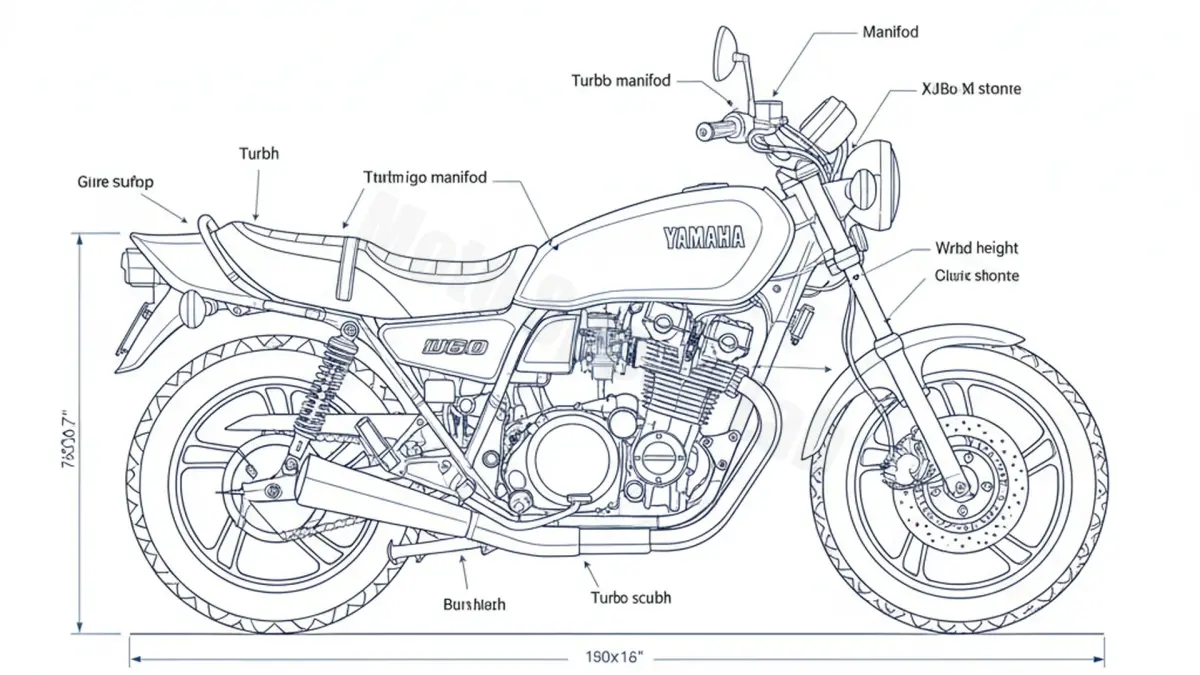
While the 1980s ‘Turbo Wars’ saw the Japanese Big Four competing for forced-induction supremacy, the Yamaha XJ 650 Turbo (11T) stood out through a unique engineering choice: it was the only turbo motorcycle of the era to utilize a pressurized draw-through system via four CV carburetors tucked behind the engine block, rather than the fuel injection systems favored by its rivals.
Technical Engineering Overview
At the heart of the 11T is a Mitsubishi TC03 turbocharger, capable of spinning up to 210,000 RPM. Unlike modern turbo systems, the XJ 650 Turbo was designed with a complex intake tract that routed air through a surge tank. This system provided a distinct power surge around 6,000 RPM, delivering approximately 90 horsepower—a significant leap over the naturally aspirated XJ650. The power is delivered to the rear wheel via a low-maintenance shaft drive, emphasizing its role as a high-speed sport-tourer rather than a pure track machine.
Maintenance Guide & Essentials
Lubrication System
Turbocharged engines are notoriously hard on motor oil due to the extreme heat generated by the turbine bearings. For the XJ 650 Turbo, we recommend a high-quality SAE 10W-40 or 20W-40 oil. Ensure the oil meets API SE/SF and JASO MA/MA2 specifications to protect the wet clutch. The total capacity is 2.5 liters. Because the turbo shares the engine oil, frequent changes (every 3,000 miles) are critical to prevent oil coking in the turbo lines.
Tires and Chassis
The 11T uses a 19-inch front and 18-inch rear wheel configuration. Stability is paramount on a bike with 1980s frame geometry under boost.
- Front Tire: 100/90-19 57H (2.0 bar / 29 psi)
- Rear Tire: 120/90-18 65H (2.25 bar / 33 psi solo; 2.8 bar / 41 psi dual)
Ignition and Electrical
Consistent combustion is vital for a turbocharged engine to prevent detonation. The 11T utilizes NGK BPR8ES spark plugs. Ensure the gap is set precisely to factory specifications to avoid spark blowout under boost. The electrical system is powered by a YB14L-A2 battery; given the age of these units, ensuring clean ground contacts is the first step in troubleshooting any charging issues.
MotoSpecsLab Verdict
The Yamaha XJ 650 Turbo (11T) is a masterpiece of early 80s ambition. While complex to tune due to its carbureted turbo setup, it remains a highly collectible piece of engineering history. For the modern owner, meticulous attention to oil quality and cooling is the key to preserving the life of the Mitsubishi turbine and the longevity of the air-cooled power plant.