| Specification | Value |
|---|---|
| Engine Type | 738cc, 3-Cylinder, 2-Stroke, Liquid-Cooled |
| Oil Specification | SAE 20W/40 (JASO MA) (1.5 L) |
| Spark Plug | NGK B8ES (Gap: 0.6mm – 0.7mm) |
| Battery | 12N14-3A |
| Front Tire | 3.25 – 19 4PR |
| Rear Tire | 4.00 – 18 4PR |
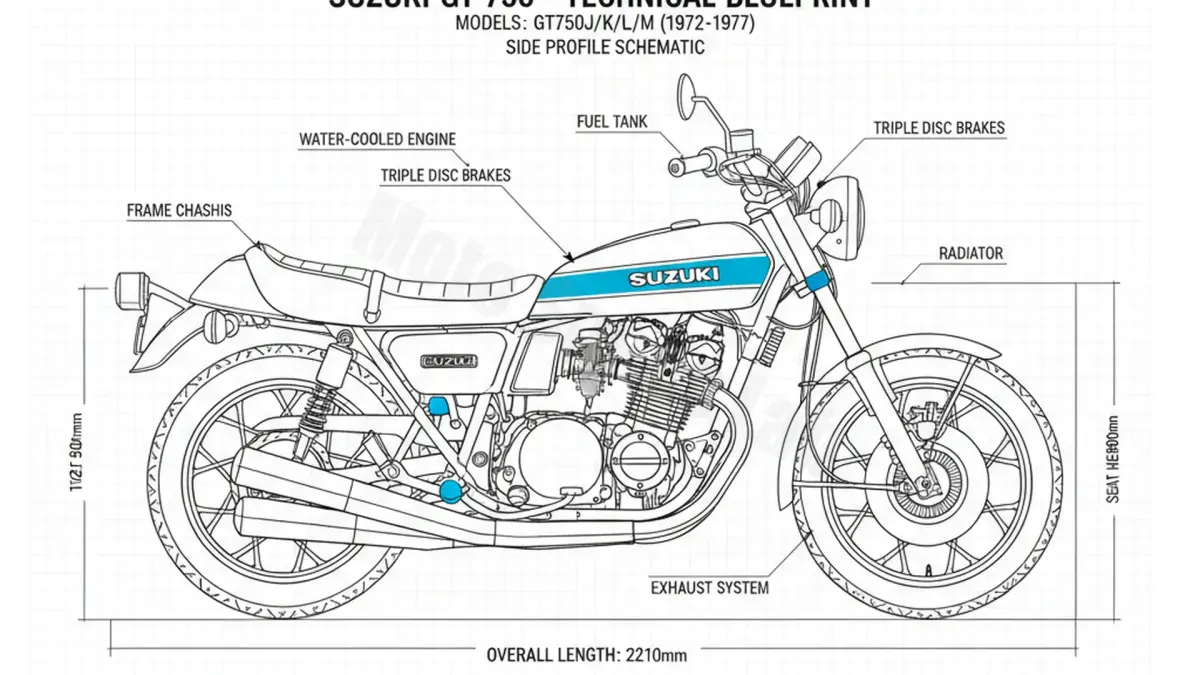
The Suzuki GT 750, affectionately known as the ‘Water Buffalo’ in North America and the ‘Kettle’ in the UK, holds a permanent place in motorcycling history as the first mass-produced Japanese motorcycle to feature a liquid-cooled engine. While competitors were chasing pure air-cooled performance, Suzuki focused on thermal stability and grand touring refinement. A unique engineering highlight of this model is the Suzuki Recycle Injection System (SRIS), designed to reduce the visible blue smoke characteristic of two-strokes by recycling residual oil from the bottom of the crankcase into the combustion chamber.
Engineering Overview
The GT 750 series (J through M models) utilized a 738cc transverse triple. The liquid cooling was not just a marketing gimmick; it allowed for tighter tolerances and consistent power delivery over long distances. The early ‘J’ and ‘K’ models featured double-sided twin-leading shoe drum brakes at the front, which were later replaced by dual discs in the ‘L’ and ‘M’ iterations to handle the bike’s significant wet weight of approximately 250kg.
Maintenance Specifications
Lubrication and Fluids
For the transmission, the GT 750 requires 1.5 liters of SAE 20W/40 oil. It is critical to use a JASO MA rated oil to ensure proper clutch operation, as modern automotive oils with friction modifiers can cause clutch slippage in these vintage units.
Ignition and Electrical
Reliable combustion is managed by NGK B8ES spark plugs. The gap must be precisely set between 0.6 mm and 0.7 mm. The electrical system is powered by a 12N14-3A battery, which provides the necessary amperage for the electric starter—a luxury for two-stroke riders of the early 70s.
Chassis and Tires
The GT 750 demands specific tire pressures to maintain its touring stability. The front tire (3.25 – 19) should be set to 1.8 bar (26 psi) for solo riding, while the rear (4.00 – 18) requires 2.0 bar (28 psi). When carrying a passenger, the rear pressure must be increased significantly to 2.8 bar (40 psi) to prevent sidewall deflection and overheating.
FAQ
What is the most common mechanical issue for the GT 750?
Crankshaft seals can harden over decades of storage. If the bike has been sitting for years, pressure testing the crankcase is vital before attempting a full restoration to avoid lean-run conditions.
Can I use synthetic oil in my GT 750?
While modern synthetics offer superior protection, ensure the oil is JASO MA compliant for the wet clutch and that the 2-stroke injection system is compatible with the specific brand of injector oil used.