| Feature | Specification |
|---|---|
| Production Years | 1999 – 2001 |
| Engine Type | Air-cooled, 4-stroke, DOHC, 4-cylinder |
| Displacement | 1251 cc |
| Oil Type / Capacity | SAE 10W-40 JASO MA (3.2 L) |
| Spark Plug | NGK DPR8EA-9 |
| Battery | GT12B-4 |
| Tire Size (Front) | 120/70 ZR 17 |
| Tire Size (Rear) | 180/55 ZR 17 |
| Tire Pressure (F/R) | 2.25 bar / 2.5 bar |
Historical Highlight: The RP02 generation marks the pivotal moment when Yamaha increased the displacement of its flagship muscle bike from 1188cc to 1251cc. This transition was not merely a bore-up; it utilized SCEM (Suzuki Composite Electrochemical Material) plated cylinders—a rare engineering crossover—to improve heat dissipation in the massive air-cooled block, making it one of the most thermally efficient air-cooled fours ever produced.
Technical Engineering Analysis
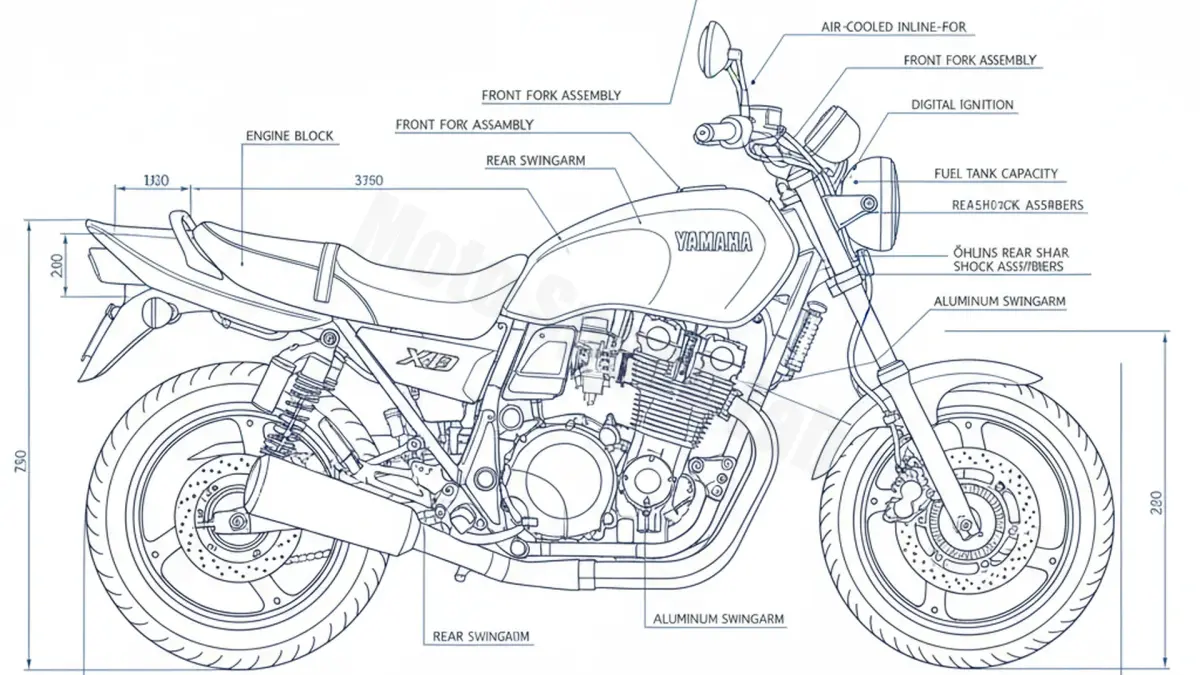
The RP02 (1999–2001) represents the pinnacle of the ‘Analog Muscle’ era. Unlike its successors, the RP02 retains the character of Mikuni BS36 carburetors, providing a linear and visceral throttle response that fuel injection struggles to replicate. The SP (Sports Production) variant further elevated the platform by introducing factory-fitted Öhlins rear shock absorbers, a distinctive ‘Sarron Blue’ or ‘King’s Replica’ paint scheme, and a more premium seat cover.
Maintenance Protocol
Maintaining the XJR 1300 requires a focus on thermal management. Because the engine is entirely air-cooled, oil quality is paramount. We recommend a high-zinc 10W-40 JASO MA oil to protect the overhead cams and the wet clutch system. The 3.2-liter capacity includes the filter change; ensure the bike is level via the center stand when checking the sight glass.
Ignition & Electrical
The RP02 utilizes the NGK DPR8EA-9 spark plug. Given the engine’s heat cycles, plugs should be inspected every 6,000 km for fouling. The electrical system is powered by a GT12B-4 battery; owners should note that the RP02’s charging system is robust, but the regulator/rectifier can be sensitive to heat—ensure the cooling fins on the unit are free of road grime.
Chassis & Handling
For optimal handling, the RP02 requires precise tire pressure management. Running the 120/70 and 180/55 ZR 17 combo at 33 psi (front) and 36 psi (rear) is the standard for solo riding. Increasing the rear to 40 psi is recommended only under heavy touring loads to prevent squaring off the tire profile.
Verdict
The Yamaha XJR 1300/SP RP02 is a masterclass in Japanese engineering. It offers a bridge between the raw power of the 80s and the refinement of the early 2000s. For the collector or the dedicated rider, it remains the gold standard for air-cooled inline-fours.