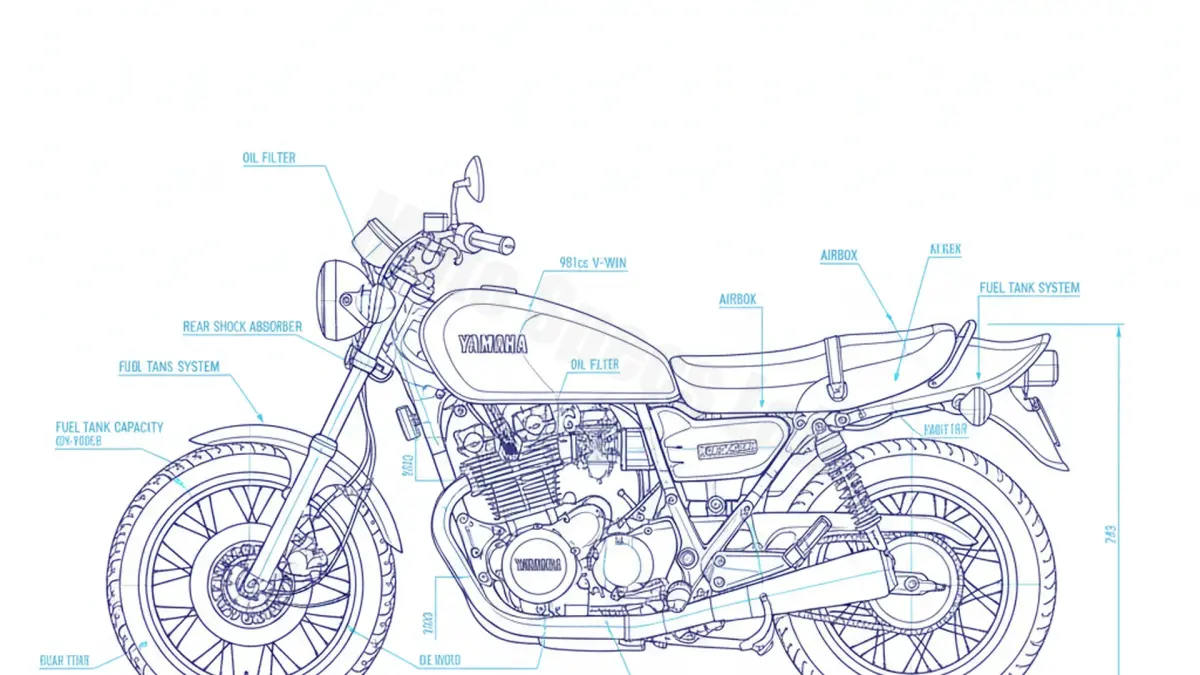
| Attribute | Specification |
|---|---|
| Production Years | 1984 – 1985 |
| Engine Type | 75° V-Twin, 4-Stroke, SOHC |
| Oil Specification | SAE 20W-40 or 10W-40 JASO MA |
| Oil Capacity | 3.1 Liters |
| Spark Plug | NGK BPR7ES (0.7–0.8 mm gap) |
| Battery | YB16AL-A2 |
| Front Tire | 100/90-19 57H (2.0 bar / 29 psi) |
| Rear Tire | 140/90-15 70H (2.25 – 2.8 bar) |
Historical Context & Engineering Highlight: The Yamaha XV 1000, particularly the 19T variant, represents a pivotal moment in motorcycle history. It was one of the first Japanese cruisers to utilize the engine as a stressed member of the chassis. By eliminating the traditional frame downtubes, Yamaha engineers significantly reduced weight and lowered the center of gravity, a design philosophy that would eventually define the modern cruiser silhouette and influence the entire Virago lineage.
Technical Review: The 75-Degree Heart
The XV 1000’s performance is anchored by its air-cooled, 75-degree V-twin engine. Unlike the more common 45-degree configurations of the era, the 75-degree angle offered a superior balance between primary vibration cancellation and the distinct exhaust note sought after by cruiser enthusiasts. The 19T model features a reliable shaft drive system, which, when paired with the high-torque output of the 1.0-liter engine, provides a maintenance-free touring experience that remains impressive even by contemporary standards.
Maintenance Guide: Keeping the 19T Roadworthy
Lubrication System
For optimal engine longevity, MotoSpecsLab recommends using SAE 20W-40 as the primary lubricant for warmer climates, or a high-quality 10W-40 JASO MA synthetic blend for versatile temperature ranges. The total capacity is 3.1 liters. Ensure the oil filter is replaced every 6,000 miles to prevent sludge buildup in the narrow oil galleries characteristic of this V-twin design.
Ignition and Electrical
The 19T utilizes NGK BPR7ES spark plugs. For peak combustion efficiency, the gap must be precisely set between 0.7 and 0.8 mm. Electrical stability is maintained by a YB16AL-A2 battery; given the high compression of the 1000cc cylinders, ensuring a high Cold Cranking Amp (CCA) rating is vital for reliable starting, especially in cold weather.
Chassis and Contact Patch
The XV 1000’s handling is sensitive to tire pressure. The front 100/90-19 tire should be maintained at 2.0 bar (29 psi). For the rear 140/90-15, pressure varies significantly based on load: 2.25 bar (33 psi) is ideal for solo riders, while 2.8 bar (41 psi) is mandatory when carrying a passenger or heavy luggage to prevent sidewall overheating.
Verdict
The Yamaha XV 1000 – 19T is more than a vintage cruiser; it is a masterclass in early-80s Japanese industrial design. Its combination of a stressed-member engine and low-maintenance shaft drive makes it a highly desirable machine for collectors who value both aesthetic heritage and mechanical integrity.