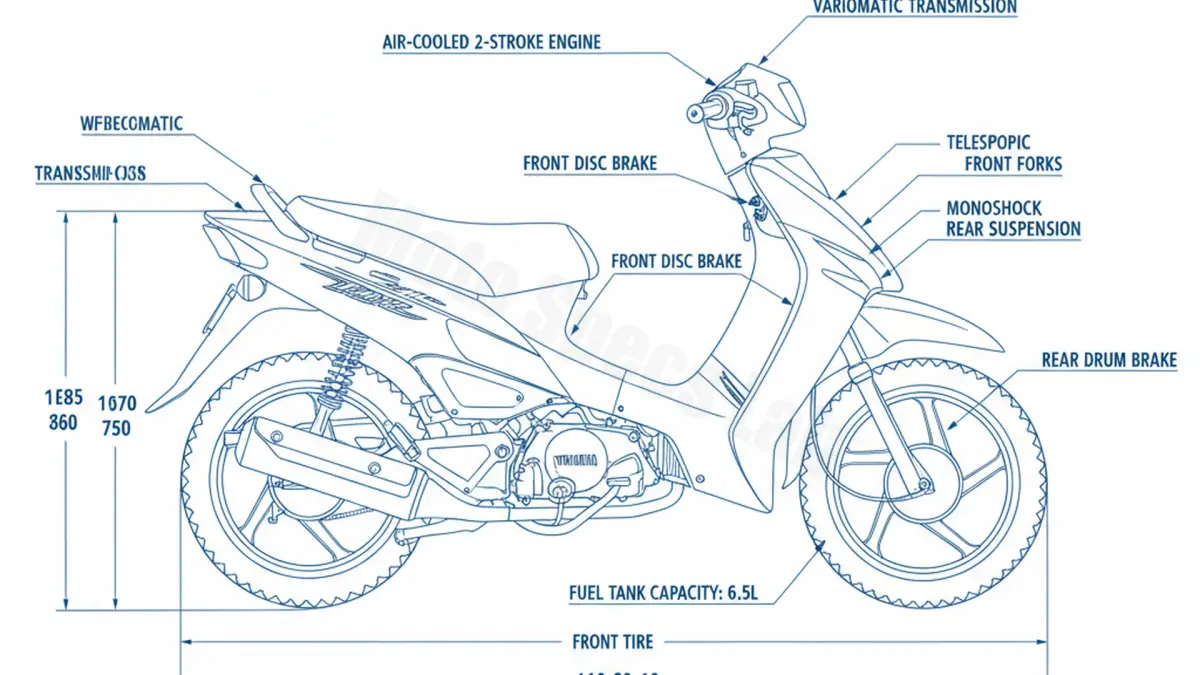
| Component | Specification |
|---|---|
| Production Years | 1993 – 1999 |
| Engine Type | 2-Stroke Air-Cooled (Minarelli Horizontal) |
| Engine Oil | JASO FC or ISO-L-EGC (2-Stroke) / 1.2 L Capacity |
| Spark Plug | NGK BPR7HS |
| Tire Size (F/R) | 100/90-10 50J / 100/90-10 50J |
| Tire Pressure (F/R) | 1.5 bar (22 psi) / 2.0 bar (29 psi) |
| Battery | YB4L-B |
The Yamaha YE 50 ZEST (4FW) holds a unique place in scooter history as one of the first models to successfully bridge the gap between utilitarian commuting and the ‘sport-city’ aesthetic that would later dominate the European market. Mechanically, it is built around the highly resilient Minarelli horizontal short-case engine, an engineering platform celebrated for its vast aftermarket support and fundamental reliability.
Engine & Performance Analysis
The 4FW power plant is a 49cc two-stroke unit designed for durability in stop-and-go urban environments. Unlike high-strung performance scooters, the Zest was tuned for a linear torque curve. To maintain engine health, it is critical to use JASO FC or ISO-L-EGC rated oils. These low-smoke synthetic or semi-synthetic blends prevent carbon buildup in the exhaust port and piston rings, which is a common failure point for older 2-stroke units. The 1.2-liter oil reservoir ensures a long range between refills.
Ignition & Electrical System
For optimal combustion efficiency, the NGK BPR7HS spark plug is the factory-standard choice. The ‘R’ denotes a resistor type, which is necessary to prevent electromagnetic interference with the scooter’s CDI unit. The electrical system is supported by a YB4L-B battery; given the age of these vehicles, checking the charging system output (rectifier) is recommended if the battery fails to hold a charge after long periods of inactivity.
Chassis & Handling Maintenance
The Zest utilizes 10-inch wheels, which provide excellent agility but are sensitive to pressure fluctuations. Maintaining the front at 1.5 bar (22 psi) and the rear at 2.0 bar (29 psi) is vital for preventing ‘cupping’ of the tire tread and ensuring stable cornering. The 100/90-10 tire size is standard, allowing for a wide range of modern rubber compounds to be fitted to improve wet-weather grip.
Maintenance FAQ
What is the fuel-to-oil ratio if the pump fails?
While the Zest uses an autolube system, if you are running premix due to a pump bypass, a 50:1 (2%) ratio of high-quality 2-stroke oil is standard for this engine architecture.
How often should the spark plug be replaced?
For the NGK BPR7HS, we recommend inspection every 3,000 km and replacement every 6,000 km to ensure reliable cold starts and peak fuel economy.
Why is the tire pressure so specific?
Small-diameter wheels (10″) have a smaller contact patch. Incorrect pressure leads to rapid heat buildup and can significantly degrade handling characteristics in a lightweight scooter like the 4FW.